
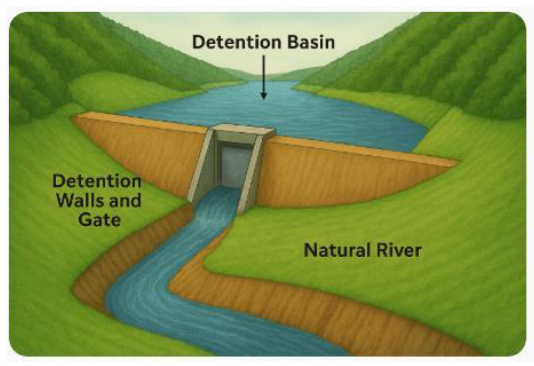
Resident Steve Posselt questions the technicalities of the CSIRO report on flooding in the Northern Rivers
Isn’t it interesting how the debate about detention dams, basins, whatever they are called, rages without technical input.
Even the report itself is devoid of engineering input. Any civil engineer will know what rapid drawdown is and what it means.
You can’t ascertain exactly what constitutes rapid drawdown without detailed soil analysis but a couple of minutes on any search engine can provide the basics.
“Rapid drawdown occurs when water levels adjacent to a slope or embankment drop quickly, potentially reducing stability due to delayed dissipation of pore-water pressures.”
“Drawdown rates of 0.1 m/day are common. Drawdown rates of 0.5 m/day are quite significant. One metre/day and higher rates are rather exceptional”.
Please research this yourself.
We know that the CSIRO has recommended 3m/day drawdown for Rock Valley.
We are still trying to deal with the multiple landslides that occurred in 2022 so we know that much of the hillsides are unstable.
We also know that the proposed impoundment is about 12km from Lismore.
Imagine that the basin fills and then the gate operator starts dropping the level at 3m per day as per instructions.
Now imagine that after a week a 200m section of hillside crashes into the remaining 20m deep water.
The resulting wave will certainly smash any gate which in turn will probably smash part of the dam.
A wave of water, maybe 3m high, will engulf Lismore, not within hours but within minutes. Loss of life would be horrendous.
It wouldn’t be dead cows floating down the river this time, it would be dead humans.
This is not fanciful imaginings. This is more probability than possibility and is based on proven engineering principles. The danger is very real.
Steve Posselt,
Swan Bay
IndyNR.com will be publishing more stories with various views on the CSIRO report.