

Susanna Freymark
Five community sessions were held this week about the CSIRO flood mitigation report – in Kyogle, Casino, Lismore, Ballina and Woodburn.
Questions in each session varied given the needs and concerns of the people living in those areas.
About 100 people attended the meeting in Kyogle, 60 people were at the Casino meeting, 580 in Lismore, about 150 were in Ballina and in Woodburn there were 180 people at the hall yesterday, Thursday, July 23.
It was clear at some of the meetings that people felt strongly about the CSIRO report and for different reasons, the discussion became particularly heated at Kyogle and Woodburn.
What the CSIRO says
From the CSIRO point of view, the final flood mitigation report shows promising results not only for Lismore but also for the entire Richmond River catchment.
CSIRO used the hydrodynamic model to test how flood mitigation measures would perform across the catchment.
“It found that strategically located water detentions and other infrastructure upgrades could reduce flood peaks, inundation extent and flood depth across the catchment.
“The larger or more comprehensive bundle of measures, known as Bundle 2, delivered the greatest benefits,” the National Emergency Management Agency website said.
“The modelling shows how water could have been held below levee banks during the March 31, 2022 flood in Lismore and significantly reduced for the February 28 event that occurred just a month earlier.
“By applying Bundle 2 measures, these flood peaks at Lismore could have been reduced by up to 1.71 metres for the March event and by as much as 2.07 metres in the February flood.”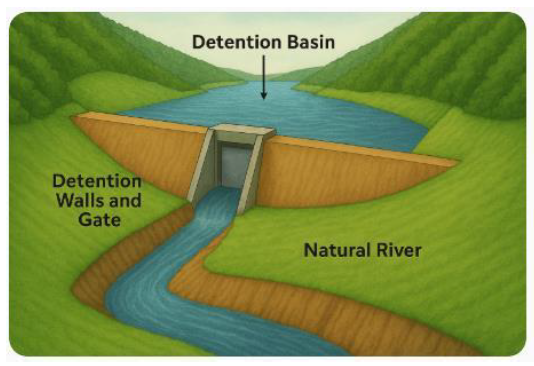
Not everyone is happy about these upstream basins
Here’s the rub – people living upstream at the locations where detention basins are proposed are not happy about Bundle 2 being the best option.
For clarity, the detention basins are being called dams by some people. A dam is designed to hold back water, a detention basin is designed to ‘detain’ water for a short period of time. In this report we will refer to them as basins, the same as the CSIRO report to avoid confusion.
At the Kyogle meeting, the idea of building 10 basins at
Rock Valley – 94.3 Gigalitres (Lismore)
Corndale – 91.3 GL (Lismore)
Booyong – 82.8 GL (Byron/Lismore)
Eden Creek – 69.4 GL ( Kyogle )
Goolmangar – 53.9 GL (Lismore)
Dunoon – 43.0 GL (Lismore)
Bentley – 40.7 GL (Richmond Valley Council)
Collins Valley – 39.5 GL (Collins Creek – Kyogle)
Fawcetts – 39.2 GL (Fawcetts Creek, Fawcetts Plain, Kyogle)
Barlings Creek – 11.3 GL (Kyogle)
did not sit well with the audience.
For comparison Rocky Creek Dam holds 14 gigalitres.
The big questions of cost and environmental impact were not yet available.
Will Prentice from the NSW Reconstruction Authority said the government had already allocated $3million to progress a feasibility study on the cost of building the basins. This is a starting figure only and the study will begin in August.
Downstream solutions
In Woodburn, people were asking about localised solutions including clearing the Bagotville Barrage, Tuckombil Canal, and opening Boundary Creek.
Cane farmer Tony Carusi said floodwater into Woodburn didn’t only come via Wilsons and Richmond rivers, but also from the Bungawalbin floodplain.
He asked the crowd at the meeting – Who supported getting the floodwater out to sea as quickly as possible?
Many hands went up.
The decision to replace the gates with a wall at Tuckombil Canal had been an economical one, Mr Carusi said.
Historically floodgates worked better, he said, as it let floodwater out and kept saltwater from getting in. The gates needed to be reinstalled.
He said opening up Empire Vale and Boundary Creek would help get floodwater out to sea more quickly.
The CSIRO package includes a Tuckean Swamp bypass, an upgrade at the Baggotville Barrage and a floodgate at Boundary Creek.
Farmer and former SES captain Jim McCormack supported getting the floodwater out of the lower river as quickly as possible for the mental health of people who are isolated and lose their livelihoods and homes during flood events.
“We must get rid of the water,” Mr McCormack said.
Why not raise the Lismore levee?
A man from Lismore asked CSIRO scientist Jai Vaze about increasing the height of the Lismore levee.
“A levee is a double edged sword,” Mr Vaze said.
“Once it overtops and pumps fail, what was held back overtops and the water cannot go back.
“The best thing is to get the water out to the ocean.”
Pumping stations are a no
A man asked about pumping stations at Lismore, Coraki and Woodburn.
He asked if the scientists had looked at countries around the world such as the Netherlands.
Mr Vaze said they had and the most advanced countries were the Netherlands and Japan.
“Pumps do not work,” he said.
He said he didn’t know if it was feasible to put a pipe from Lismore to the ocean.
“It doesn’t make sense to have a pipe underground to the ocean,” Mr Vaze said.
What are other countries doing?
A Dutch man said the Netherlands been dealing with inundation forever.
“There will always be water here,” he said.
“This country needs to study, study, study – not five years after but 30 years before they occur.”
He spoke about the use of dykes to manage water in Holland and spread it before it flowed to towns.
His solution was to build a 300m wide channel behind the airport at Lismore.
The audience clapped loudly.
Why aren’t we dredging the river?
At the Casino meeting several farmers asked why the rivers weren’t being dredged.
Chris Magner told the audience how vessels used to travel from Ballina up the river to Lismore.
“They used to bring vessels to Irvington Wharf,” he said.
“The channel has choked and it is not allowing the volume of flow.
“You can walk across the river now at Irvington.”
Mr Vaze said there was a lot of opposition to dredging from environmental groups.
“CSIRO has nothing against dredging, we went with the majority.
“The numbers for dredging did not stack up.”
What about nature based solutions?
At each session, nature based solutions were brought up.
Mr Vaze said for large floods, nature based solutions have not been shown to work.
Nature based solutions are mentioned in the CSIRO report, but the focus was engineering solutions.
Release of the water
One man stood up and was concerned about the release of water from the 10 proposed basins.
“The dams will flood a lot of country that’s never flooded before,” he said.
Mr Vaze explained there would be a slow release of the floodwater.
Another man stood up and became emotional.
“I’m 80 next week and I’ve seen every flood and you don’t realise what we went through,” he said.
“We have made sure it will not make things worse in Coraki,” Mr Vaze said.
“We will hold back 160gigalitres and we would release water when it becomes safe.”
Relocate Lismore
At each meeting, in the milling around afterwards, there was always someone who would suggest that Lismore CBD be relocated. It’s an idea that has been put forward for years – one of the most radical.
Meeting practice
After the Kyogle meeting, there was criticism about the lack of a mic, chairs and structure to the meeting. There also weren’t any maps showing where the basins would be placed. This was rectified for the Casino meeting where several times, NEMA staff were asked to have a meeting held outside of working hours. Initially this was refused but at the last minute, the Ballina meeting was extended beyond 5pm to 7pm.
Too late for other mitigation ideas, CSIRO says
In the previous round of community sessions in June last year, Mr Vaze and his team of scientists asked the community to prioritise what mitigation solutions the CSIRO should study.
This did not include dredging or pump stations. It was about how to hold the water back and detention basins was one of the chosen priorities.
“We did not know the final results of tested scenarios,” Mr Vaze said.
“Our role is finished now.”
The CSIRO report outlines Bundle 1 and Bundle 2 and one resident asked who decides which approach will be done.
Mr Prentice said there aren’t any boundaries yet.
“We need to assess Bundle 1 and 2,” he said.
One man asked about other solutions.
“There is a gap in the discussions,” he said.
And back to the cost
A man at the Casino meeting said the cost of building the 10 detention basins could easily “blow out.”
“It’s up to the government. I cannot comment on costs,” Mr Vaze said.
Difficult times
These meetings have not been easy for residents as many relive the days of flooding.
It has been difficult to hear what the speakers were saying and to understand the process at the meetings.
One woman asked why the video showing the scenario of water detention was not played and why there was no power point.
Our opinion
As an observer, IndyNR.com found the meetings did not empower the community that attended. This was not a place to be heard but more an exercise in community consultation with the agenda already decided. This is troubling.
The feasibility study begins next month and will take some time before the government – and the community find out how much it will cost.
Then comes the decision on whether to proceed or not.
It is a fraught process for those impacted by flood and the memories that shadow their lives. We will be watching this space and reporting back to you. Read the report here.